1. Materialisation
“Computer insists there’s an object in Command Center.”
Commander John Koenig looked up from the duty log. Maya was frowning at her console in the way she did when the numbers were behaving badly, which on Alpha was often enough that everyone had learned to read the frown.
“Where?”
She touched the controls. The main screen shifted from star field to a floor plan of Command Center, and a red square began to pulse near the centre of the room.
“Six metres from where you’re standing.”
Koenig looked at six metres from where he was standing. Floor. Nothing else.
Tony Verdeschi wandered over from the security station with the air of a man whose morning had just been ruined. “I don’t suppose it would care to say what the object looks like.”
“It can’t determine that.”
“Mass?”
“Fluctuating.” Maya paused. “Between two point three tons and infinity.”
Tony nodded slowly. “Of course.”
Helena Russell had come in from the medical section and was halfway to Koenig when the lights flickered. Every monitor in Command Center filled with static at once. And under the static, rising, came a sound none of them had ever heard: a grinding wheeze that swelled and fell like something old and enormous trying to catch its breath.
Koenig’s commlock was already in his hand. “Security to Command Center.”
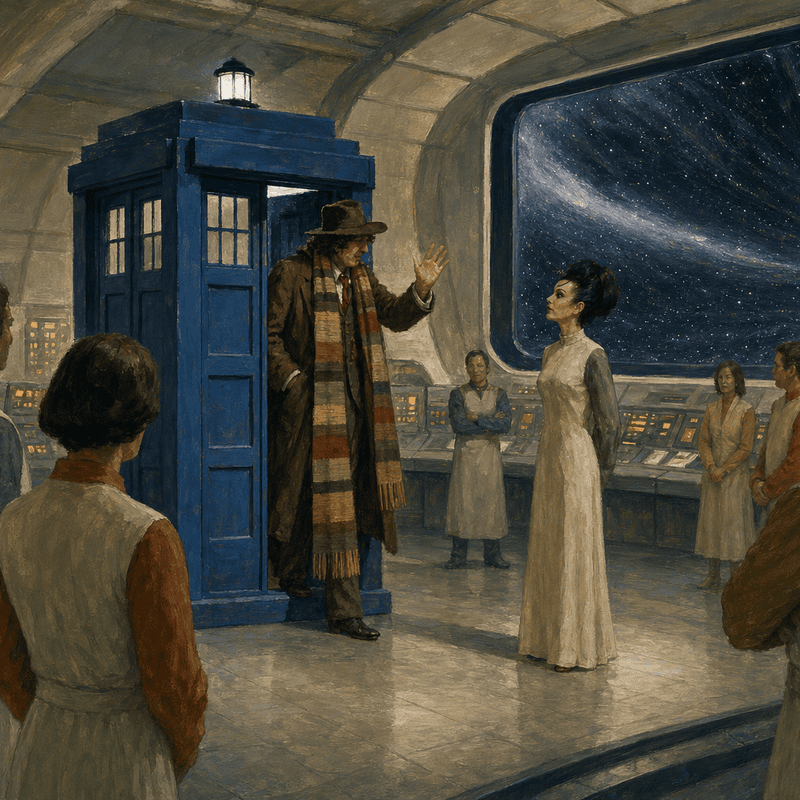
The air six metres from him shimmered. Something blue appeared, not all at once but in pulses, solid and then not and then more solid each time, until the sound stopped and there was a tall blue wooden box standing in the middle of Moonbase Alpha with a light on top. The light flashed once and went dark.
Above the doors, white on black, it said POLICE PUBLIC CALL BOX.
Maya stepped toward it.
“No,” Koenig said, and caught her arm.
The door opened outward and a man stepped out.
He was tall, taller than Tony by a head, wrapped in a brown coat and a scarf that appeared to have been knitted by someone who did not understand when to stop. Under a mass of curly hair and a broad-brimmed hat, a pair of enormous pale eyes took in the room, the consoles, the four security men who had just come through the doors with stun guns levelled, and lit up with what Tony would later describe to Koenig, with some irritation, as sheer delight.
“Artificial gravity,” the man said. “Sealed environment. Fusion plant somewhere underneath us.” He beamed. “Oh, marvellous. A space station.”
Nobody lowered anything.
“Unless it’s a hotel. Very severe management.”
“Hands where I can see them,” Tony said.
“They’re right here.” The man held them up. One was holding a small white paper bag. “Would you like a jelly baby?“
2. Two Hearts
Koenig had met a great many strange things since the Moon tore loose of Earth. Planets that dreamed. A man who claimed to be God and very nearly was. He had learned to reserve judgement.
He was reserving it now, hard.
“Your name.”
“The Doctor.”
“Doctor who?”
“No. Just the Doctor.” The tall man had settled into a chair without being invited and was gazing at the big screen, where the star field crawled by as it always did. “Is that live? That’s live, isn’t it. Where are we? No, wait.” He spun the chair to face the sensor board and squinted at it. “Solar system, but no sun. You’re in deep space. On a base built for orbital operations. That’s not right at all.”
“Who else is in the box?” Koenig said.
“No one. Not at the moment.” Something crossed his face and was gone. “I’m between friends.”
Helena had her medical scanner out. She ran it across his chest, stopped, and ran it back.
“John.”
“What.”
“He has two hearts.”
“Usually,” the Doctor said.
Tony looked at him. “Usually?”
“Long story.” The Doctor popped a jelly baby into his mouth.
Koenig came around the console. “You’re not human.”
“Well spotted. Neither is she.” The Doctor tilted his head toward Maya, who had not taken her eyes off him since the box arrived. He looked at her properly for the first time, at the faint stippled colour at her temples and the eyebrows that swept up like the wings of something in flight, and something in his face went still and then bright. “Oh. Oh, you’re a Psychon. I’ve never met a Psychon. Cellular restructuring at will, is that right? Full molecular transformation?”
Maya said slowly, “For an hour at a time. How do you know that?”
“I know a lot of things. Most of them are useless. That one wasn’t.” The brightness dimmed, the way weather changes. “Psychon’s gone, isn’t it. I’m sorry. I’m very sorry.”
Maya said nothing. Tony put a hand lightly on her shoulder.
Koenig had had enough. “What do you want here?”
“I was pulled here. And I’d very much like to know what by, because I have a nasty feeling whatever’s caught me has caught you as well.” The Doctor stood, and the scarf swung. “You should also know, Commander, that I’m almost certainly a threat to Alpha.”
Tony’s hand went to his weapon.
“Not intentionally.”
“That’s not reassuring.”
“It wasn’t meant to be.”
Maya had come closer while they talked. She was circling him now, the way she circled a specimen. “Your body temperature is too low for a human. Your readings contradict each other. There’s something else, something the scanner can’t reach.” She stopped in front of him. “I could find out.”
“No.”
It was the first word he had spoken without humour in it, and it landed like a dropped tool.
“When I transform,” Maya said to Koenig, without looking away from the Doctor, “I reproduce the physical structure of another life form. Nervous system. Molecular template. I would know what he is.”
“You’d get more than my shape. You’d get my senses. All of them.” The Doctor’s voice was low. “And I don’t think you’d enjoy it. Please don’t. I’m asking you nicely.”
Maya held his gaze for a long moment.
“All right,” she said. “For now.”
3. The Date
They gave him the date because there was no reason not to.
“September the eighth,” Sandra Benes read off the log. “Two thousand and two, Earth calendar. Day one thousand and ninety-one since Breakaway.”
“Breakaway,” the Doctor repeated.
Alan Carter, leaning against the Eagle status board with his arms folded, told it the way Alphans always told it: the nuclear waste dumps on the far side, the magnetic buildup nobody understood until it was too late, the thirteenth of September 1999, the flash, the Moon kicked out of orbit like a stone from a sling. Three hundred and eleven people on a base designed for a hundred and eighty days of independent operation, sailing through the dark for three years and counting.
The Doctor listened without interrupting, which Helena, watching him, suspected was rare.
When Alan finished, the Doctor was silent for a long moment.
“I’ve been to 1999,” he said finally. “I’ve been to 2002. I was in London in 2002, as it happens, and I distinctly remember the Moon being exactly where it should have been. Full, rather lovely, hanging over the Thames.”
“Then you’re lying,” Tony said, “or you’re mad.”
“Or I’m from somewhere else. Commander, this is going to sound like a lie, and I’d rather it didn’t. In every version of Earth’s history I have ever walked through, and I’ve walked through a great many, the Moon never left. The dumps never went critical. Alpha was decommissioned quietly in 2004 and there’s a museum on the site now with a truly awful gift shop.”
Nobody spoke. On the big screen the stars kept crawling.
“You’re saying we shouldn’t exist,” Helena said.
“No. I’m saying something much stranger. I’m saying you do exist, all of you, on a Moon that took a different fork in the road.”
“History doesn’t fork,” Koenig said.
“Doesn’t it? Time is not a river, Commander. It’s a delta. Most of the channels are shallow and dry up in an afternoon. A few run deep.”
Maya had turned back to her console. “And this one runs deep enough to pull your ship across from the next channel over.”
The Doctor pointed at her. “Yes. Which takes a great deal of force. Which is why I want to know what’s pulling.”
“There’s a mass ahead of us.” Maya was already bringing it up. “Bearing eight degrees off our line of drift. I logged it two days ago as a rogue body, a burned-out stellar core. It isn’t radiating. But…” She adjusted something. The screen shifted, and the star field bent. The stars themselves stayed where they were. The space between them was what moved, pulled and stretched like a sheet with a weight in the middle. “It’s warping the field around it far more than a body that size should. And our drift vector has been curving toward it since I first logged it. I put that down to ordinary gravitation.”
“It isn’t ordinary,” the Doctor said quietly. “That’s a fracture. A crack in the delta. Something’s been thrown into it, and it’s pulling everything nearby into the gap. My TARDIS was caught by the edge. You’re being caught by the middle.”
“Can we outrun it?” Koenig asked. “Eagles, full burn, every thruster we can rig?”
Alan shook his head. “We’ve tried nudging the Moon before, Commander. You know what it does. Nothing.”
“How long?”
Maya ran it. “Three hours before the tidal stress exceeds the structural tolerance of the base. Perhaps less.”
“And then?”
“And then,” the Doctor said, “there won’t be a Moonbase Alpha to argue about which timeline it belongs to.”
4. The Plan
They met in Koenig’s office, which was not much of an office: a desk, a wall of status panels, the low hum of the base around it. Koenig, Helena, Tony, Maya, Alan. The Doctor sat on the edge of the desk and swung one long leg.
“A fracture in space-time is a wound,” he said. “Left alone, it heals.”
“It’s not healing,” Tony said.
“Because something in there is keeping it open. Fractures don’t hold themselves. Someone falls in and gets stuck, and their being stuck becomes the thing that keeps the wound from closing.”
“Someone,” Helena said.
“Almost certainly. A ship, a pilot, a creature. Something with a will.”
“Then get it out,” Koenig said. “Or get it to let go. Either one closes the fracture?”
“Either one starts it closing. That’s the dangerous bit. Alpha is already halfway into the crack. When the edges come together they’ll come together fast, and anything caught between them goes with them. That’s what the TARDIS is for. She can hold the edges steady long enough for the Moon to clear. But she can’t fly to it. She travels by unfolding herself into the vortex and folding out again somewhere else. Try that at the lip of a fracture and she’d unfold into the fracture. She has to work from here, and someone has to be at the wheel when the edges move, and that’s me.”
“So who goes in,” Alan said.
“Not you. Not any of you. Not me either.” The Doctor looked at each of them. “Inside a fracture, time isn’t laid end to end. It’s spread out sideways. Every direction is somewhere else. A human being can walk in. He can’t walk anywhere. He’ll wander until the field wears him down, and it does wear you down. Slowly. The thing in the middle has been dying in there for what it thinks is forever and what’s probably been a few weeks. An Eagle would fare no better. Alan, you’d be a very well-preserved fossil.”
Alan said nothing.
“Then there’s no one,” Koenig said.
“There’s one.” The Doctor did not look at Maya. He looked at Koenig. “A Psychon’s cells never fully settle. Whatever shape she takes, underneath it she’s still fluid. She’s not locked to any one moment the way you and I are, so the field can’t wear on her the way it would on us. That’s half of it. The other half is knowing which way is out. I can see time, Commander. It’s what I am. If she were shaped like me, she’d see it too.”
Helena caught it first. “You want her to become you.”
“An hour ago I asked her not to. Now I’m asking her to.” He turned to Maya at last. “You’d be the only creature in the universe with a Time Lord’s sense of direction and a Psychon’s refusal to hold a shape.”
“And what happens to her when she takes it?” Helena said. “You looked frightened before.”
“I was. I still am. She’ll see everything I see. Not just this room. Every moment I’m standing in, all at once, with no walls between them. It’s not a thing a mind is built for. Mine had seven hundred and fifty years to get used to it. More or less. She’d get it in a second.”
Maya said, “Can it be survived?”
“I think so. I think if you know it’s coming, and you hold on to who you are, you can ride it. I’m not certain.”
“Then we find out here,” Koenig said, “in Medical Center, with Helena beside her, before I put her in an Eagle. That’s not a request.” He looked at Alan. “Flight time to the edge?”
“Forty minutes. I can put her right on the lip.”
“She changes in the airlock. That’s her hour. Doctor, how much of it can she spend?”
“Twenty minutes in. Twenty out. Twenty spare. And the spare twenty is the part that keeps her alive, so I’d rather she didn’t spend it.”
“Twenty minutes in,” Koenig said to Maya. “Then you turn around, whatever you’ve found. Tony, you’re with me in Command Center. Any objection?”
Tony looked at Maya. She looked back.
“No, Commander,” he said.
5. The Shape
They did it in Medical Center, with the doors sealed and Helena’s monitors running and the Doctor sitting on the edge of a bed with his hat in his hands.
“Don’t reach for it,” he told her. “That’s the mistake. You’ll feel it all opening up and you’ll want to look at everything at once. Don’t. Pick one thing. Pick something in this room and hold it, and let the rest go past.”
“What did you pick?” Maya asked. “The first time.”
“I don’t remember. I was very young.” He turned the hat over. “Pick Tony. He’s easy to find. He’s very loud.”
Tony, at the door, said nothing, which for Tony was a great deal.
Maya closed her eyes.
The air around her shivered, and for a moment she was a luminous outline with nothing inside it, and then the outline filled in with brown curls and a brown coat and a scarf that went on too long. The Doctor looked at himself. Helena’s monitor let out a single sharp tone as the second heartbeat came up on the trace.
Maya opened the Doctor’s eyes.
And screamed.
She went down. The Doctor was off the bed and on the floor beside her before Helena could move, gripping the shoulders of the coat she wore. “Maya. Maya, you’re in Medical Center. It’s the eighth of September. Tony’s at the door. Find him.”
Her breath came in ragged pulls. Her eyes, his eyes, were open and looking at nothing, or at everything.
“I can see it,” she said, in a voice that was almost his and not.
“Yes.”
“All of it. The Moon. The explosion. Earth, before. Earth, after.” Her hands closed on his wrists. “Psychon.”
“Those aren’t my memories, Maya. They’re yours. You’re only seeing them with my eyes. Let them go past.”
“I can see where Alpha is going.”
The Doctor went still.
“Where?” Koenig said from behind Helena.
Maya turned the Doctor’s face toward the bulkhead, and the eight-degree bearing beyond it that she could not possibly see through solid rock.
“Into it. There’s nothing on the other side. It just stops.”
A tear ran down the Doctor’s borrowed face.
“That’s why we’re going,” the Doctor said. “That’s exactly why. Now find Tony.”
She found him. It took a long minute, and Helena counted every second of it on the trace, but the breathing slowed and the hands loosened and the eyes came back from wherever they had been and fixed on the security chief at the door, who had crossed the room without anyone noticing and was crouched at arm’s length.
“There you are,” Maya said, in a voice that was hers again even if the face was not.
“Here I am,” Tony said.
The Doctor sat back on his heels and let out a breath.
“She can do it,” he said to Koenig. “God help her, she can do it.”
6. The Edge
The Doctor walked her to the Eagle pad himself. She was herself again, the hour saved, and the base around them had begun to make small sounds it did not usually make: a tick in the bulkheads, a long low groan from somewhere in the rock.
“You’ve done this before,” Maya said. “Fixed things like this.”
“A few times.”
“Did anyone die?”
The Doctor did not answer immediately, which was an answer. “Whatever’s in there has a will,” he said instead. “And they may not want to be brought out. You’ll have to bring them anyway. Or you’ll have to leave them.”
“Which one closes the fracture?”
“Either.”
Maya considered that with the same stillness she brought to everything. “My father,” she said, “kept a planet alive for years past the point where it should have died. He fed it with the minds of the people who came to it. He told himself it was necessary. I loved him. He was wrong.” She met the Doctor’s eyes. “I know the difference between saving something and refusing to let it go.”
The Doctor smiled, and there was nothing whimsical in it at all. “Yes,” he said. “I rather thought you might.”
Tony was waiting at the pad. He did not say anything useful, because there was nothing useful to say, and she did not make him.
“Come back,” he said.
“Someone has to drink the third batch.”
He laughed, once, and it came out wrong, and she was in the Eagle and the hatch was sealing.
The Doctor went the other way, back toward the blue box, and did not look behind him.
Alan Carter flew Eagle One the way he always flew, which was as though the ship were an extension of his own nervous system and slightly annoyed at being asked to slow down. Maya sat behind him in the command module and watched the distortion grow on the forward monitor until the stars ahead were smeared into arcs.
“Alpha, Eagle One,” Alan said. “This is as close as I go, kids. Field’s eating my instruments. I’ll have her on comm until the hatch cycles and then I’ve got nothing, so don’t ask me how she’s doing.”
Koenig’s voice came back thin and flat. “Understood. Maya, the Commander’s clock is twenty minutes in. Turn around when it runs out.”
“Understood, Commander.”
Alan half-turned in his seat. “And the pilot’s clock is sixty. That’s your hour. If you’re not back through that hatch at sixty I’m coming in after you, and I don’t care who says otherwise.”
“Alan,” Koenig said, “you heard the Doctor. You’d never find your way out.”
“Then I won’t find my way out, Commander.” Alan turned back to his controls. “Hatch cycling. Clock starts when you change.”
Maya stood in the airlock with the outer door cycling open onto a wall of bent light. She closed her eyes, and the air shivered, and a tall man in a brown coat stood where she had been.
“Mark,” Alan said. “Sixty minutes.”
The outer door finished opening. The Doctor’s shape stepped into the distortion and was gone.
7. The Inside
The first thing she understood was that the Doctor had told her the truth, and not all of it.
He had said time was spread out sideways in here. He had not said there was no forward. Every second of the place was laid down side by side like tiles on a floor, and she could step from any tile to any other, and none of them led anywhere. There was only elsewhere, in every direction, forever.
A human being would have been lost in the first ten seconds. She could feel that. She could feel, too, the thing that was not lost: the borrowed senses she wore knew which tile came next, by orientation, the way her own body knew which way was down. She let them choose. She walked.
There was one clock in the fracture that worked, and it was the one in the Doctor’s head.
Four minutes. Nine. Fourteen.
The ship was at the centre of it. Small, ugly, single-seat, a survey craft of a design she did not recognise. It was not moving and it was not still. It was every moment of its own arrival at once, and in the pilot’s chair, held in all of them, was the pilot.
Not human. She could not have said what. The field had been at them for what they believed was forever and what the Doctor thought was weeks, and it showed. What was left was mostly will: a will like a hand clamped on a doorframe, refusing to be pulled through.
Twenty-two minutes. The Commander’s clock had run out somewhere behind her. She did not turn around.
She spoke to them. The Time Lord shape allowed for it, in a way that was not entirely speech.
You’re holding the door open.
The answer was slow and came from a long way off. If I let go I end.
Yes.
Then I hold.
There’s a Moon behind me, she said. Three hundred people. When you hold the door, it pulls them in. They’ll end too. All of them. Not instead of you. As well as you.
Nothing.
I can’t carry your ship, she said. I can carry you. I don’t know what’s on the other side of the door for you. I don’t know if it’s anything. But I won’t leave you like this, and I can’t make you come.
Twenty-nine minutes.
You would carry me out to die.
I’d carry you out to finish. She was surprised by how steady the voice was. It was his voice, but the steadiness was hers. My father held a door like this. He held it for years. He fed it with other people’s lives and called it saving them. I loved him, and he was wrong, and I was the one who had to tell him so. She held out the Doctor’s hand. I’m telling you so.
Thirty-four minutes.
The hand on the doorframe let go.
She felt it before she saw it: the tiles under her feet shifting, the whole laid-out floor of the place beginning, slowly, to fold. The wound was closing. The Doctor had said it would be fast, and it was not fast yet, but it was going to be.
The pilot was light. She lifted them from the chair and turned, and her borrowed sense of time found the next tile, and she stepped.
Forty-one. Forty-eight.
At fifty-three minutes she felt the first tug at the edges of the shape, the Psychon underneath the Time Lord beginning to want its own form back. Seven minutes. The fold was moving faster now, tiles sliding under her, and she could not run because there was nothing to run along, only steps, and each step had to be the right one.
Fifty-seven. The scarf was gone. She had not decided to let it go. The coat was going.
Fifty-eight. The sense of direction flickered like a lamp in a draught, and for one step there was no next tile at all, and she stood on nothing and held the pilot and did not move.
Then it came back, and she saw the lip. The bent light of the edge, and beyond it the flat ordinary dark, and in the dark a hatch.
Fifty-nine.
She stepped through the wall of light with the last of the Doctor’s eyes, and the shape went, all at once, and it was Maya who fell through Eagle One’s outer hatch onto the airlock floor with a dead pilot in her arms, forty seconds before the hour.
8. The Closing
Alan had the Eagle in motion before the outer door was fully shut.
“Alpha, Eagle One. I’ve got her. She’s alright. She’s alright, Tony.” A pause. “She’s got somebody with her. I don’t think they made it.”
In Command Center, Tony sat down.
Koenig did not. “Doctor.”
The Doctor’s voice came from inside the blue box, six metres from the command console, where Computer had spent the last three hours insisting it weighed two point three tons and also infinity. The doors were shut. “I heard. It’s been closing slowly since she got them loose. It won’t be slow much longer. Alan, put everything you have into getting clear of the lip, you’ve got about a minute. Everyone else, hold on to something.”
The base shuddered, deeper than an Eagle landing hard or a strike on the surface, as if the rock itself had shifted its weight. A panel at the rear of Command Center let go of its housing and swung on its cables.
“Structural stress at eighty percent of tolerance,” Sandra said. “Rising.”
“Doctor.”
“I know.”
“Ninety.”
The grinding wheeze rose in Command Center, the same sound that had brought the box in, but it did not stop this time. It held. The light on top of the box burned white and stayed white. On the big screen the smear of bent stars ahead of the Moon flexed and began to fold toward itself, and the base groaned like a ship in a heavy sea.
“Ninety-five.”
“Sandra,” Koenig said, “if you tell me a hundred, I want to hear it after.”
“Ninety-eight.”
“Eagle One’s clear,” Alan said, thin with distance. “Whatever that was, it went past behind us.”
The stars snapped. One instant they were a smear, and the next they were points, sharp and steady and ordinary, as if someone had pulled a cloth taut. The shuddering stopped. The wheezing wound down and the light on the box went dark.
Sandra’s board went green across every panel. “Drift vector normalising. We’re pulling off the mass. It’s… Commander, the mass is gone. It’s just gone.”
Koenig let go of the console.
The TARDIS door opened. The Doctor stood in it, hat in hand, looking somewhat greyer than he had.
“She held,” he said. “Good girl. Is there any tea?“
9. Departure
They buried the pilot on the surface, in the shadow of the base, with the few words Koenig could think to say for someone whose name and world nobody would ever know. Maya stood at the grave a long time after the others had gone in.
The Doctor found her there, in an Alphan suit that did not quite fit him. She told him, over the suit radio, what she had said to the pilot, and what the pilot had said back. He listened the way he had listened to Alan telling Breakaway, without a word.
“You did the right thing.”
“I know.”
“That’s not the same as it not hurting.”
“I know that too.”
They walked back to the airlock together. When the helmets came off she was quiet for a while, and then she asked him the question he had been expecting since the office.
“Your ship. It travels in time.” She kept her voice level. “You could take the Commander and Helena and the others home.”
“Could I fit you all inside? Of course I could. That’s not the difficulty.”
“Then what is?”
“Where would I take you? My Earth already has you. Or had you. Three hundred people with lives, families, records. Possibly three hundred other versions of yourselves, walking about, wondering why they feel watched. And a Moon overhead that never went anywhere. I’d be unloading a whole population into a world that has no room for it and no way to explain it. It would be a second Breakaway, only this time I’d be the one who did it.”
She nodded, as if she had known that.
“And Psychon.”
He said nothing.
“I could see where it was. When I was you. Not where. When.” Her voice stayed level. He could see what it cost her to keep it there. “You could take me there. Before it ended.”
“Maya.”
“I know.” She was looking at the airlock door, not at him. “I know what I said to you on the way to the pad. I meant it. I still mean it. I’m asking anyway.”
“I know you are.” The Doctor’s voice was gentle. “And the answer’s no. Not because I can’t. Because it’s the thing I’ve spent seven hundred and fifty years learning not to do, and you already know why. You told a stranger why, in there, with my mouth.”
She was silent for a long moment.
“Then I’ll stay,” she said. “This is home. It’s a strange one. It’s mine.”
Tony caught him at the TARDIS door with a mug.
“You’re not leaving without trying it.”
The Doctor took the mug, sniffed it, and drank. His face went through several expressions in quick succession, most of them involuntary.
“Well?” Tony said.
“I’ve had worse,” the Doctor said, and handed the mug back. “On Skaro. Under torture.” He paused. “Keep at it. The third batch is usually the one.”
Koenig was there too, with Helena, and Alan, and Maya. The Commander held out his hand and the Doctor shook it.
“Where will you go?” Koenig asked.
“Back to my own channel of the delta, if she’ll take me. It’s a bumpy crossing.” He stepped into the doorway and turned. “Commander. For what it’s worth, and I know it isn’t much. In my version of things, Alpha is a museum with a gift shop. In yours, it’s the most extraordinary story I’ve come across in a very long time. Don’t let anyone tell you you’re the wrong Moon.”
The door shut.
The wheezing groan rose in Command Center, and the light on top of the box flashed, and the box faded, and the floor six metres from the command console was just floor again.
Maya looked at her console.
“Computer reports no object in Command Center.”
“About time,” said Tony.
On the big screen, the stars crawled on, steady and sharp, toward wherever the wandering Moon went next.
End.