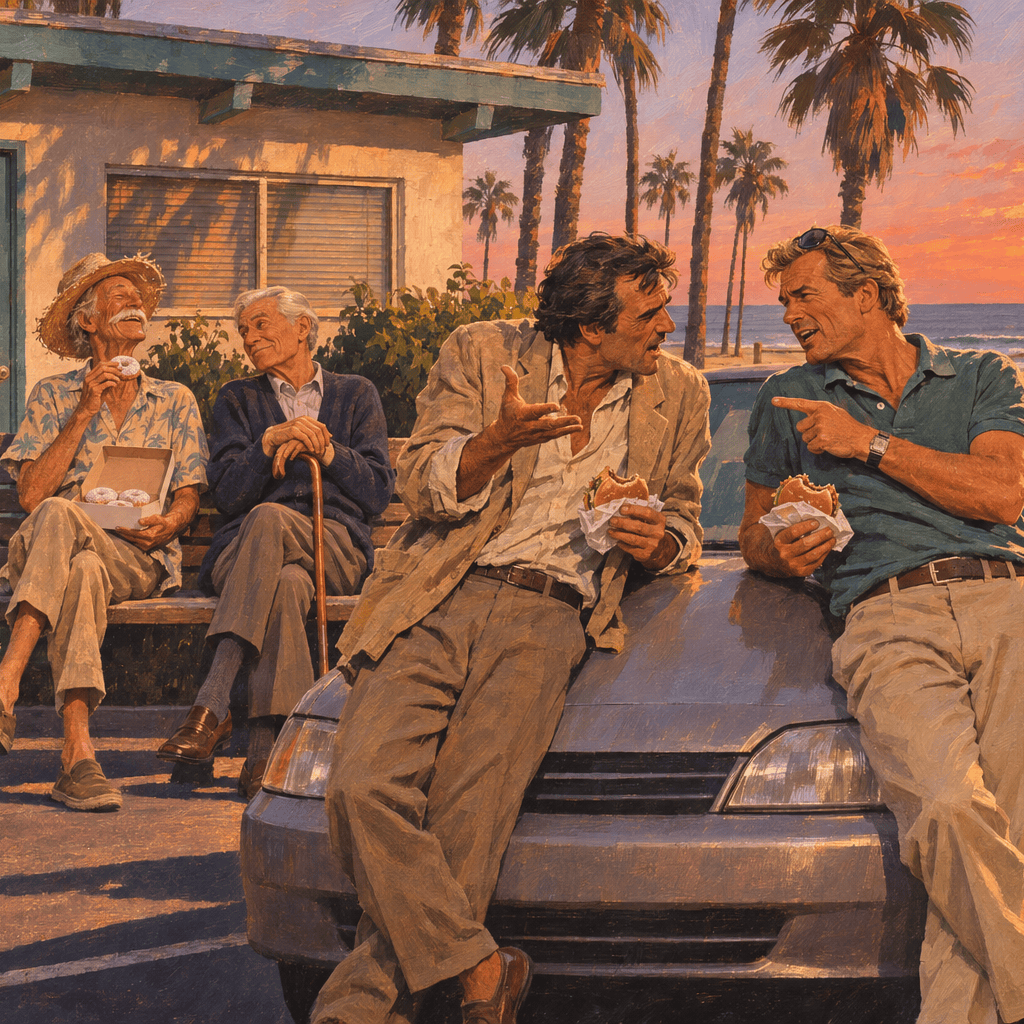
I couldn’t sleep last night. So instead of doing something sensible, I stayed up pitching a Simon & Simon revival to ChatGPT.
If you don’t remember it, Simon & Simon was a detective show on CBS. It premiered in November 1981 (45 years ago this week, as it turns out) and ran for eight seasons. Rick and A.J. Simon were brothers who ran a private detective agency in San Diego. Rick (Gerald McRaney) was the Marine veteran with the pickup truck. A.J. (Jameson Parker) was the neat one with the Camaro. They argued about everything and they solved the case anyway.
Here’s my idea. McRaney and Parker are both 79 now, and you can’t ask two guys that age to carry a detective show. So their sons get the agency. The dads still show up, but only for a few minutes at a time, and the rest of San Diego is full of actors you haven’t seen since about 1985.
By morning I had a whole series treatment. The ideas are mine. ChatGPT’s job was to keep up, take notes and type it all up into the document below. All I’ve done since is reformat it for the blog.
TELEVISION SERIES • DEVELOPMENT PROPOSAL
The Simons (working title)
Same family. Same business. A whole new set of problems.
One-hour detective dramedy | Contemporary San Diego | Approximately 52 minutes per episode
Alternate titles, should good judgment temporarily fail: The Simons: The Next Generation and Simons 2: Electric Boogaloo. The producers reserve the right to deny ever discussing either.
Logline
Two middle-aged cousins inherit their fathers’ San Diego private investigation agency, balancing complicated cases, complicated families and two fiercely independent aging detectives whose lifetime of friendships may be the greatest investigative resource in Southern California.
The room pitch
We’re bringing back Simon & Simon, but we’re not asking two eighty-year-old men to carry a detective show. Their sons inherit the business. We discover two new leading men, give a generation of veteran television actors another chance to shine, and make a funny, occasionally gritty, unexpectedly moving detective series for Generation X. Sometimes that guy really is Barry Van Dyke. Sometimes it isn’t. Either way, they’re watching next week.
Unofficial revival proposal. All casting is illustrative; rights and participation are unconfirmed.
The series
More than forty years after Rick and A.J. Simon first entertained audiences, the family business continues. Their respective sons, in their forties or early fifties, are capable private investigators with complementary skills, complicated lives and the easy familiarity of men who have known each other forever. They have clients, ambitions, families, relationships and financial obligations. They also have fathers.
Retirement has not made Rick or A.J. easier to deal with. The sandwich generation now finds itself caring for men who have absolutely no interest in being cared for. Fortunately, their inheritance includes something more valuable than a detective agency: a lifetime of relationships. Somewhere in San Diego, somebody knows something. The boys just have to find him. And occasionally fix his printer.
Story engine
A compelling investigative A-story is supported by a personal, professional or family B-story. They may intersect, but need not. Standalone mysteries, occasional recurring adversaries, action and humor remain the foundation. Some episodes have nothing to do with the fathers or nostalgia. Exceptional finales can go genuinely dark, in the tradition of Magnum, P.I.’s “Did You See the Sunrise?”
The new leading men
Find two experienced, underutilized actors rather than purchasing celebrity. Think the next Don Johnson, or the television equivalent of Brooks & Dunn: two individually capable performers whose partnership makes stars of both. Audition individually; cast as a pair. Avoid the Coy and Vance Duke problem by creating new characters, not substitutes.
The definitive chemistry test: can they sit in a parked car eating hamburgers and arguing about absolutely nothing for five minutes and make compelling television? Their personalities should develop around the performers. They need not resemble their respective fathers; reversing inherited traits may be more interesting. They are professionals. Their families are the problem.
Creative north star
Affection without sentimentality. Nostalgia without pandering. Humor without cruelty. Drama without manufactured misery. Trust the audience. And occasionally, deliberately and lovingly f*ck with them.
The original brothers
Invite Gerald McRaney and Jameson Parker to reprise their roles, subject to interest, availability and appropriate accommodations. Most episodes feature neither. An occasional ninety-second to five-minute subplot featuring one father is special. Both together should be an event: perhaps a major finale, or a family Christmas special. Scarcity protects the new leads and gives the original stars manageable schedules.
Growing old without growing irrelevant
Rick and A.J. are elderly, stubborn, occasionally forgetful and physically limited. They are also experienced detectives. Let them be ridiculous without making them pathetic. Rick insists he can handle surveillance; his son finds him asleep in the truck.
SON: Dad! You’ve been asleep for two hours!
RICK: I was resting my eyes.
SON: Did you even see anybody leave?
RICK: Blue Honda. Woman in her thirties. Red purse. Florida plates.
SON: How the hell did you—
RICK: You got any more of those little powdered doughnuts?
A.J. refuses his colonoscopy. Rick and the cousins practically have to kidnap him to get him to the appointment. Later they discover Rick hasn’t seen a dentist in nine years. A.J. has been waiting for revenge.
Rick’s romantic adventures
At least one brother, potentially Rick, is widowed. His surprisingly active social life is a recurring source of comedy, companionship and occasional tenderness. The women have independent identities and professional histories; some may become favorites in their own right.
SON: Dad, she’s eighty!
RICK: So am I. She still looks good at the pool.
SON: Gross, Dad.
RICK: She bought me Speedos.
SON: Please tell me you didn’t wear them.
Rick grins.
RICK: I didn’t.
Cut away.
The senior center
The secret weapon: an ordinary community facility with an extraordinary concentration of retired judges, accountants, engineers, intelligence officers, physicians, military personnel and investigative reporters. Ordinarily they would tell the boys to get lost. But they know their dads.
The competition has expensive databases, AI and sophisticated forensic equipment. The Simons have Walter, retired NSA, Tuesdays and Thursdays, usually by the pool. Their inherited advantage is goodwill, not technology. Assistance may cost a trip to Costco, printer repair, or the settlement of a thirty-five-dollar poker debt. The recurring phrase: “I know a guy.”
The Hungarian document
A client brings in an unidentified Hungarian document dated 1973. The boys take it to an elderly gentleman buttering a muffin.
OLD MAN: Where’d you get this?
SIMON: Why?
OLD MAN: Because I wrote it.
Cut to commercial.
A performer such as Barry Van Dyke anchors a serious Cold War mystery. Three episodes later, he is back complaining about the muffins. His extraordinary past does not invalidate his ordinary present.
Rick’s Newman
Dirk Benedict could play Rick’s inexplicable nemesis, a charming retired rogue with considerable expertise in confidence schemes. The rivalry has no explained origin. A.J. likes him, which makes matters worse. Rick is convinced he deliberately parks in Rick’s favorite spot.
SON: Dad, it’s a public parking lot.
RICK: That’s not the point.
Across the lot, Benedict waves cheerfully.
RICK: That motherf*cker.
In a serious episode, the rival puts himself at risk to help Rick’s son. Rick quietly thanks him. Six episodes later they are fighting over parking. The old people get their moments. The senior center is sometimes Del Boca Vista, sometimes the Pentagon. It is never the entire show.
A world of their own
The cousins have their own community outside the senior center. Recurring locations and relationships develop naturally; these are illustrative casting possibilities, not commitments.
Lisa Bonet: the confidante
An eclectic Ocean Beach bookstore with a coffee bar. A woman with a long, affectionate, complicated history with one cousin. She is his Guinan: the person he visits for perspective rather than information. Maybe they were lovers; maybe the relationship occasionally crosses that line again. Or not. Let the chemistry and the writers decide, without forcing a season-long romantic arc.
Tracy Scoggins: the rival
The sophisticated owner of a competing detective agency. She steals prospective clients, is irritatingly competent, and occasionally must cooperate with the boys. A.J.’s advice: get everything in writing.
Marg Helgenberger: the police contact
A veteran homicide lieutenant who knows the family professionally. She remembers the fathers’ tricks and has no patience for their sons repeating them. A serious dramatic anchor.
Lauren Hutton: the client from hell
An elegant, wealthy woman whose arrival guarantees that whatever the boys had planned for the weekend is no longer happening. The money is excellent. The situation is very, very complicated. She has history with the original brothers.
SIMON: She’s offering fifty thousand dollars.
COUSIN: For what?
SIMON: She won’t say over the phone.
COUSIN: Call your dad.
Later, she arrives: “Before we discuss anything else, do either of you have a valid passport?”
Stanley Tucci: the restaurateur
An aspirational guest for a strong script. A charming Italian restaurateur with a complicated past. The cousins pay for their meals; Rick and A.J. apparently do not. Nobody knows why. The restaurant can recur without its proprietor appearing every time.
Casting and discovery
Seek recognizable but potentially underutilized television, film and music performers associated with roughly 1975–2000. Think Robert Pine rather than Ponch and Jon; Stephanie Zimbalist rather than Pierce Brosnan. The ideal reaction is “Holy sh*t, honey, it’s that guy from that show.” Availability, compensation and willingness must be checked individually.
Illustrative wish list: Barry Van Dyke, William Katt, Thom Bray, Joe Penny, Perry King, Dirk Benedict, Robert Pine, Stephanie Zimbalist, Erin Gray, Terry Farrell, Denise Crosby, Kelly LeBrock, Stefanie Powers, Tracy Scoggins, Lisa Bonet, Lauren Tewes, Todd Bridges, Christopher Knight, Sean Young, Marc Alaimo, Dennis Franz, Tom Wopat, Leif Garrett, Rex Smith, Megan Mullally and Michael McKean. More expensive names are selective aspirations, not budget assumptions.
Give them their moment
Ricardo Montalbán in The Wrath of Khan is the philosophical touchstone: a familiar television personality delivering a remarkable dramatic performance. Give veteran performers material worthy of their craft. Dennis Franz as a retired detective confronting a possible wrongful conviction; Marc Alaimo as an impeccably polite, quietly menacing businessman. Erin Gray might teach tai chi, drawing on real interests, but her character can have a substantial dramatic life beyond that.
Accommodate older performers with manageable shooting schedules. If an appearance is merely adequate, thank the performer and move on. If an actor is delightful, dramatically exceptional or has unexpected chemistry, bring them back. Listen to directors, actors and audiences without outsourcing creative judgment to testing.
The spin-off generation engine
Fonzie happened. Betty White’s Hot in Cleveland role grew beyond its intended pilot appearance. Do not predetermine the breakout character. Introduce people organically and let the writers discover whom they want to write for. One day a writer says, “Dammit, we need the judge,” and the whole room understands why. The senior center and the larger community are natural backdoor-pilot incubators: a popular pairing can be tested within the parent series before any separate development commitment. The detective show remains the priority.
Sample episode: The robot
The proof of concept. The cousins investigate an attempted burglary at a computing history museum. The intruder ignored valuable exhibits and tried to steal an apparently worthless homemade robot from the 1980s.
Its creator, an eccentric retired computer engineer portrayed by Thom Bray, mined Bitcoin in its earliest days as an intellectual curiosity. He concealed the private key using the robot’s obsolete storage technology. The boys discover the attempted theft may involve a fortune.
SIMON: What the hell is this?
ENGINEER: It’s a tape.
SIMON: A what?
ENGINEER: A tape.
The investigation brings them into contact with retired computer enthusiasts, obsolete equipment, forgotten technical standards and dangerous individuals who understand what the robot contains. Somebody knows a guy. Two hours of arguments about the Commodore 64 later, the boys finally find someone who has the equipment they need.
The engineer is more furious that somebody damaged his robot than concerned about the money. The ending might find him in a newly equipped workshop, painstakingly restoring his beloved creation.
For viewers who remember Riptide, Thom Bray and the robot provide another layer of delight. For everyone else, it is a good mystery involving cryptocurrency and obsolete technology. If the original Boz and Roboz characters and design are cleared, use them; otherwise develop genuinely independent characters and designs with legal review. Silence alone does not eliminate rights obligations.
Why it works
A contemporary crime, organic nostalgia, generational comedy, genuine stakes and an emotional center. It does not require Rick or A.J. to appear. It belongs early in the season, after the new leads establish their identities. This is the template: good mystery first, nostalgia second, character throughout.
Adversarial nostalgia
Generation X does not necessarily want its memories reverently presented back to it. It appreciates irreverence, skepticism and realizing that the people making the show are deliberately messing with it. Sometimes that familiar face really is the actor. Sometimes it is a lookalike. Sometimes the object on the bookshelf is an Easter egg. Sometimes it is just an object. Do not routinely explain which is which.
The Gary factor
GARY: Holy sh*t, honey! Pause it!
WIFE: Why?
GARY: It’s that guy. From that show.
WIFE: Oh, dear Lord.
Later:
GARY: That’s Barry Van Dyke.
WIFE: Maybe it’s just some guy who looks like Barry Van Dyke.
GARY: I KNOW BARRY VAN DYKE.
WIFE: You didn’t know our neighbor’s name for seven years.
Eventually she is checking Reddit before he does. They realize the production is deliberately f*cking with them. They love it. They watch another episode. The Simon boys investigate a crime; their audience investigates the casting department.
The inverse Masked Singer
The viewer sees someone clearly and must determine whether that person is even a celebrity. No obligatory reveal. Cast a Barry Van Dyke lookalike, then the real Barry three episodes later. Cast Kevin Miles (Jake from State Farm) in an unrelated role; later cast the original Jake separately. Put unrelated people in khakis. Cast an actor who played young Elton John as a hotel pianist playing Billy Joel. Populate a restaurant’s framed celebrity portraits with lookalikes, perhaps one genuine photograph. All likeness and contract requirements apply.
A Dylan lookalike plays a locksmith. A licensed Dylan song plays over the credits. Nobody acknowledges it. If the real Dylan ever agrees to appear, cast him as somebody else entirely and play no Dylan music. The audience’s confidence is never safe.
Easter eggs, music and rules
The four lights
Marc Alaimo, remembered as Gul Dukat, appears in a serious episode. His office contains four lights. Briefly, it contains five. The famous four-lights scene actually involved David Warner’s Gul Madred; the production knows this. Six weeks later Reddit notices. If a statement becomes necessary: “We can neither confirm nor deny the acquisition, placement, removal or illumination of any lighting fixtures associated with the episode.” Release it April 5, First Contact Day.
The Love Boat rule
Robert Reed and Florence Henderson’s brief buffet encounter illustrates the desired restraint. Former co-stars can cross paths without explanation. Rick has Major Dad reruns playing in the background; An Accidental Cowboy sits among ordinary books; a Cylon figurine rests on Dirk Benedict’s bookshelf. Dennis Franz in a hospital gown almost gives us the famous NYPD Blue camera angle. Cut away. Michael McKean’s amplifier may go only to ten. The joke belongs to the audience, not the characters.
Music
License the one-hit wonders and cult favorites, subject to cost and clearance:
- “In a Big Country” (Big Country)
- “Mexican Radio” (Wall of Voodoo)
- “The Politics of Dancing” (Re-Flex)
- “Der Kommissar” (After the Fire)
- “Obsession” (Animotion)
- “Major Tom” (Peter Schilling)
- “Under the Milky Way” (The Church)
- “Welcome to the Boomtown” (David & David)
- “Tenderness” (General Public)
- “I Melt with You” (Modern English)
Let songs play naturally on car radios or in restaurants. Not every choice needs to comment on the plot.
Rules of engagement
Research references meticulously. Deliberate mischief is not an excuse for factual mistakes. Preserve fair investigative clues and the credibility of the fictional world. No explanatory dialogue, knowing glances or gratuitous close-ups. Do not routinely confirm speculation or publish Easter egg guides. Never compromise a serious emotional scene for a gag. The intended reaction is an affectionate, exasperated “Those motherf*ckers.”
Episode length: 52 minutes. Viewing time: two hours. (A joke, not a measured audience statistic.)
The emotional heart
What happens when the men who taught you to navigate the world become the men you are responsible for taking care of? Aging, independence, companionship, illness, family obligations and loss belong in the series, without becoming its sole subject.
When the old men get serious
After a season of brief comic appearances, the cousins find both fathers sitting in the office. Neither is smiling. Rick locks the door. A.J. says, “Boys, we need to talk.” Roll opening credits. An old adversary or unresolved case has placed the next generation in danger. The fathers need not become action heroes again. Their courage, judgment and knowledge are enough.
When reality intervenes
If either original actor dies during the run, consider acknowledging the loss respectfully, in consultation with the surviving performer and families. No sensationalized death for a revenge plot, no recasting or artificial resurrection. Allow grief and then allow life to continue. A Christmas special featuring both brothers might become especially precious in retrospect.
The Camaro
An old Camaro sits under a cover in A.J.’s garage. He has been meaning to restore it for years. Should his death become part of the story, his son inherits it. Across several episodes, almost entirely in the background, we see a new part on a workbench, grease on his hands, an evening alone in the garage.
Finally, at the end of an otherwise ordinary episode, the engine turns over. He smiles. “There you go, Dad.” Cut to the car traveling along the California coast. For this moment, the original Simon & Simon theme plays, subject to clearance. No flashbacks. No monologue.
Six episodes later, the cousins eat takeout in the Camaro on a stakeout. Nobody mentions the car. Nobody mentions A.J. It has become part of everyday life. In a small way, Dad is still working cases with the boys. Much later, Rick might sit in the passenger seat, touch the dashboard and say, “Still smells the same.” Back to the case.
Why now?
The original audience has aged alongside the characters. It remembers a shared television culture and now understands the challenges of middle age, caring for parents and raising children. The series offers a contemporary procedural that recognizes those experiences without treating the audience as a demographic to be pandered to. Its commercial hypothesis is that good mysteries, meaningful intergenerational stories and participatory viewing can generate repeat viewing and word of mouth. That hypothesis is not yet validated.
The show offers veteran performers interesting work while they are willing and able to participate. Some will enjoy a dignified cameo; some may have an unexpected career renaissance. Two new actors will have the opportunity to become television stars. Flexible supporting contracts and thoughtful production accommodations are development goals, not established budget savings.
Development requirements
Secure underlying franchise and character rights before production. Review crossover references, props, music, likenesses, lookalike casting and credits. Verify performer status, interest, availability and compensation. Develop and chemistry-test the leads, commission a pilot and establish a realistic production budget. The characters, actors and episode concepts in this treatment are proposals, not secured commitments. The title is provisional.
Closing statement
Make a show people look forward to watching. Make them laugh. Occasionally break their hearts. Give forgotten actors another moment in the sun. Give the writers latitude. Never forget the boys have a detective agency to run. And occasionally make grown men scream at their televisions about the number of lamps in an office.
THE SIMONS
Same family. Same business.
From the executive producers who cannot be trusted.
Share with me: Who’s your “that guy from that show”? Tell me who else should be hanging around the senior center. Comments are open. 💬